
What is The Council in Eclectic Leadership? 16 Questions & Answers

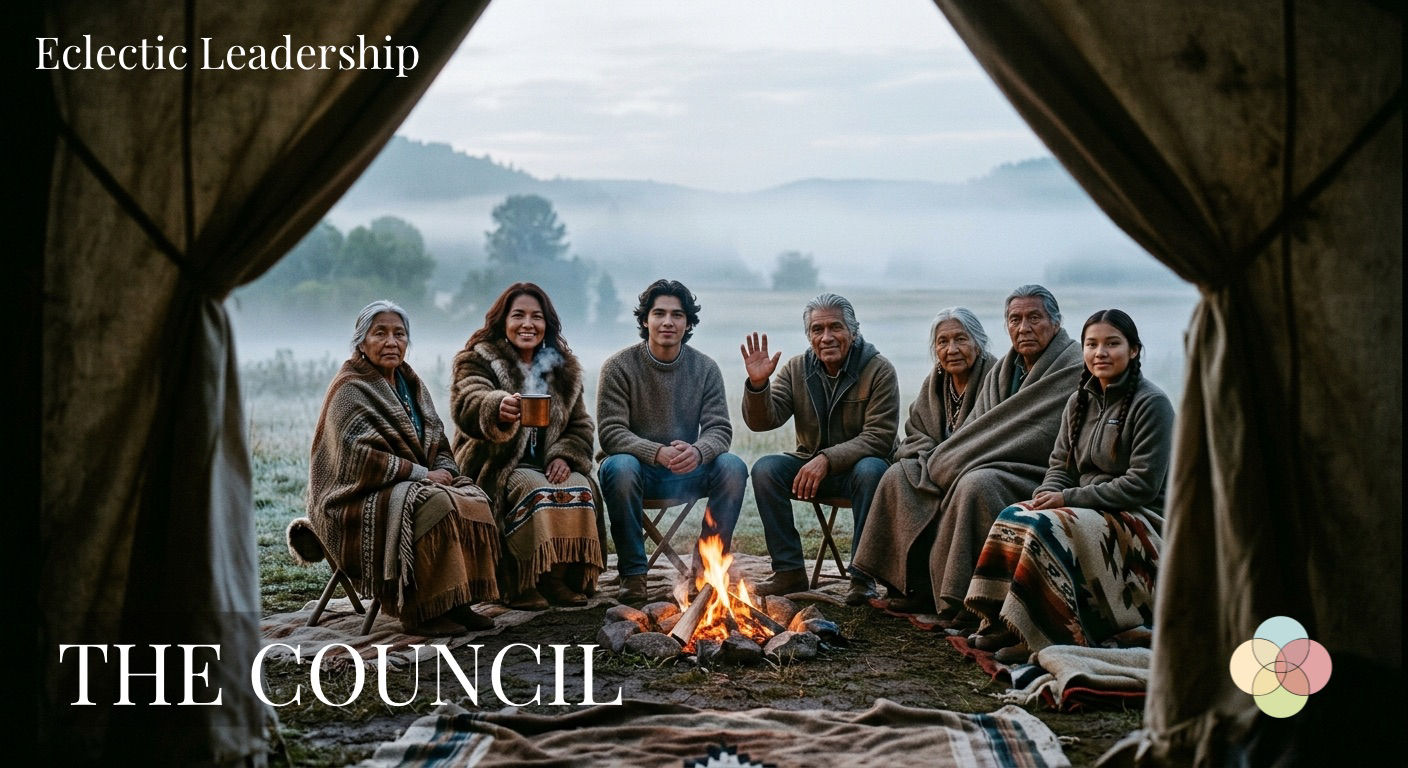
The Council of Eclectic Leadership is a many-to-one advisory model. A small group of deliberately different specialists, which can include linguists, psychologists, coaches, trainers, educators, entrepreneurs, architects, writers and journalists, curated specifically for the decision in front of you, convenes around one high-stakes decision, tests it together with you, and then disperses once it's resolved.

It is not a standing panel, a board seat, or a series of coaching sessions. It exists for one decision at a time. The main problem it solves is decision loneliness. Leaders are rarely short of advice. They're short of several genuinely different perspectives testing a decision together, in the same conversation, before it hardens, rather than one relationship at a time reflecting it back to them afterwards.
A single coach, however good, still leaves you as the leader to do the hardest part alone: synthesising everything into a final call. The Council removes that solitary synthesis step by putting the synthesis where it belongs, with people chosen specifically to disagree usefully, not left for you to work through alone afterwards.
What it asks of you is simple: bring the decision, not a request. You name a specific, legacy-level decision, one that outlives you rather than one that resolves by next quarter. The Council convenes, tests it from several genuinely different angles, and helps you resolve it. What you get at the end is clarity you can act on, tested rather than assumed, and a decision that has already survived the disagreement it would otherwise have met later, in public, at a worse time.
Eclectic Leadership runs on three questions: how do I learn well, how do I lead well, how do I leave well. The Council answers the third one. It's built for legacy builders and leavers, people already thinking beyond their current role, their current organisation, even their current lifetime, not for the kind of decision that resolves itself by next quarter.
What happens if you skip this and decide alone instead. The decision hardens before anyone tests it. It gets committed to, announced, treated as settled, and only afterwards does the blind spot show up, the one a second or third perspective would have caught before it cost anything. The clean-up then costs more, in time, money and trust, than convening the right people would have cost at the start.

Why do CEOs feel lonely even when they're surrounded by people all day?
Because being surrounded by people is not the same as being able to talk to them honestly. A CEO can have a packed calendar and still have nobody close enough to openly challenge the decision they're about to make. Half of CEOs report feeling this kind of loneliness, and 61% of that group say it actively hurts how well they do their job (Saporito, HBR, 2012). Think of it like standing in a crowded lift where everyone can see you but nobody can actually help you press the right button.
Is that your fault?
No. It is a structural gap, not a personal failing. Most organisations build support around the CEO's schedule, not around their decisions. Nobody sat down and designed loneliness into leadership on purpose, but the way support gets built, one relationship at a time, ends up producing it anyway.
So what did the industry build to fix it?
Executive coaching. One coach, one client, working through decisions together. It is a real solution and a genuinely useful one, worth somewhere between $94.8 billion and $103.56 billion depending on the year you check (Mordor Intelligence, 2024-2025). But it solves loneliness by adding one more person, not by rebuilding what surrounds the leader entirely. It is still one voice talking to one voice.
What did leaders rely on before coaching existed as an industry?
Older, tested patterns that gathered several people around one decision. Juries decide guilt as a group, not by asking one juror. Hospitals use tumour boards so no single specialist carries the hardest calls alone. Presidents have kept kitchen cabinets. Councils of elders have existed for as long as there have been elders willing to disagree with each other in front of the person who needed them to. The pattern is always several different voices testing a decision together, before it hardens, not one voice reflecting it back.
What is the Council of Eclectic Leadership, in plain terms?
A group of deliberately different specialists who convene around one specific decision, help you work it through, and then disperse. You bring the decision, not a request for coaching. A named convenor keeps the process on track. Once it's resolved, the Council closes. Nothing ongoing, nothing standing.
Who actually sits in a Council?
It depends entirely on the decision in front of you, that's the whole point. The specialists can include linguists, psychologists, coaches, trainers, educators, entrepreneurs, architects, writers and journalists, among others. What they are not is a random compilation of impressive job titles. Each Council is carefully designed and curated around the specific requirement of the person convening it, so a succession decision might draw a very different mix of specialists than a market entry decision would, chosen for genuine relevance to the decision and genuine difference of view, not for how the group looks on paper.
Isn't that just a board of advisors with a different name?
No. A board protects the organisation. Fixed seats, a standing schedule, a duty that outlives any single decision. A Council protects the person's decision. One issue, then it closes. There is no seat to keep warm for next quarter.
Why not just book five separate coaching sessions instead?
Because five separate opinions still leave you as the only place they ever meet. You'd be doing the hardest part alone afterwards, weighing five different views against each other with nobody to test your reasoning against. In a Council, the specialists test each other's read on the decision directly, in front of you, so you're not the sole synthesiser.
Can AI just do this instead of a human Council?
Partly, and it's worth being honest about where. AI is genuinely useful for rehearsal, for structuring your own thinking before you take it anywhere else. The AI avatar market alone is projected to grow from around $0.80 billion in 2025 to $5.93 billion by 2032 (MarketsandMarkets, 2025), so this is a real and growing capability. But a single AI coach and a single human coach are structurally the same shape: one voice, answering you one at a time. The actual divide was never human versus AI. It was always one versus many.
Doesn't putting more people around a decision just increase the risk of groupthink?
Yes, if the people aren't genuinely different from each other. More voices are not automatically better than one good voice, boards prove that regularly. This is exactly why curation matters more than headcount, a linguist, a psychologist and an entrepreneur will genuinely disagree with each other in useful ways, while three people from the same industry with different job titles will mostly agree. A Council assembled without that discipline produces the same diplomatic mush a weak board produces, just with better branding attached. Confidentiality and accountability are real costs too. Five people knowing something is a bigger circle than one, and a named convenor stays responsible for making sure disagreement turns into a decision rather than a polite stalemate.
What actually happens once a Council convenes?
You bring the decision. Specialists chosen for genuine difference convene around it. A named convenor holds the process together while you keep ownership of the decision throughout. Once it's resolved, everyone disperses, and anything identifiable about you is stripped out so the pattern can help the next leader facing something similar.
How long does a Council actually take?
Realistically, several sessions spread across three to six months. A decision serious enough to bring to a Council usually has enough moving parts, and enough at stake, that it deserves to be tested properly rather than rushed through in one sitting. What is fixed is the ending: once the decision is resolved, the Council closes. It was never built to run indefinitely the way an ongoing coaching relationship does, it's sized to the decision, not to a retainer.
What do you actually get out of it?
Three things. Clarity, you stop guessing at what you think once it's been tested against genuinely different views. Connection, you stop carrying the decision entirely alone. Confluence, your judgement lines up with the wider values around you rather than sitting in isolation from them.
What happens if a leader keeps making these decisions alone instead?
The decision hardens before anyone tests it properly. It gets committed to, announced, treated as settled, and only afterwards does the blind spot show up, the one a second or third perspective would have caught before it cost anything. The cleanup then costs more, in time, money and trust, than convening the right people would have cost at the start.
Does the Council apply to any decision, or only certain kinds?
Only certain kinds. It sits specifically within the Eclectic Legacy question, how do I leave well, not every decision a leader ever faces. If the decision is mainly about your own growth, or how you guide one person through a specific moment, a coach is usually the right fit, and a faster, simpler one. The Council becomes the right tool once the decision is the kind that outlives the person making it: succession, what gets left behind, a call that reshapes what comes after you rather than what happens next quarter. That's a deliberately narrower bar than "any big decision," and it's meant to be.
So how do I know whether I need a coach or a Council?
Neither answer is right or wrong. It depends on what the specific decision in front of you actually needs, not on which model sounds more impressive. A short filter, ten questions, about ninety seconds, can help you work that out honestly. Try it, and see where you land.
Eclectically yours,
Shehzaad
London, UK
Sources
Saporito, T. J. (2012). It's Time to Acknowledge CEO Loneliness. Harvard Business Review. Based on the CEO Snapshot Survey: 50% of CEOs report loneliness in the role; 61% of that group say it hinders their performance.
Mordor Intelligence (2024, 2025). Executive Coaching and Leadership Development Market reports. Market size estimated at USD 94.80 billion in 2024, rising to USD 103.56 billion in 2025.
MarketsandMarkets (2025). AI Avatar Market report. Market projected to grow from USD 0.80 billion in 2025 to USD 5.93 billion by 2032, at a CAGR of 33.1%.


Comments